











Ratan Tata Success Story & Biography: The Legacy of an Indian Icon
Explore the inspiring success story and life of Ratan Tata. Discover how his visionary leadership, global acquisitions, and deep philanthropy transformed the Tata Group into a worldwide empire.

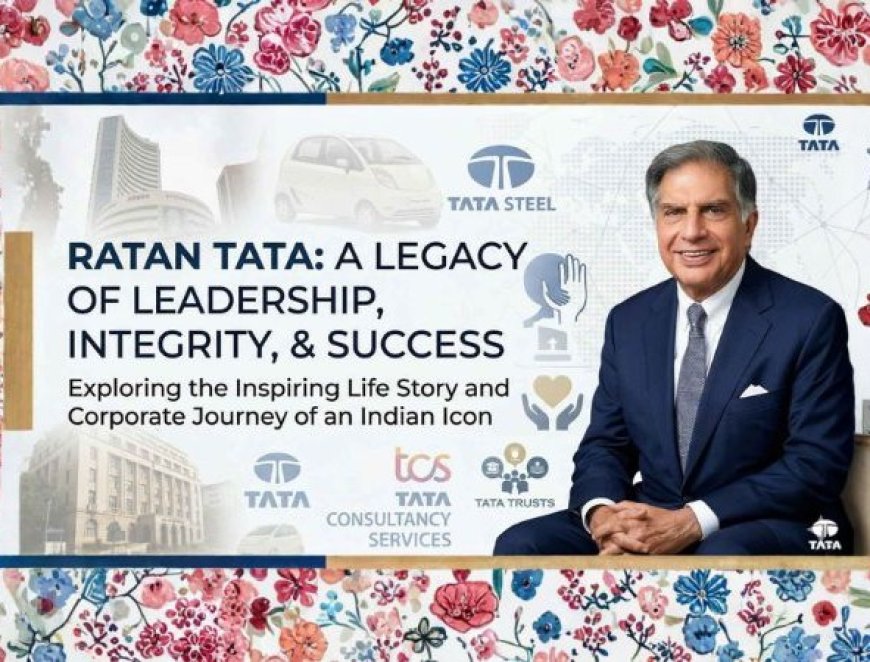
The Architect of Modern India: Ratan Tata's Inspiring Success Story and Enduring Legacy
When discussing the architects of modern Indian industry, one name stands above the rest: Ratan Naval Tata. An industrialist, philanthropist, and the visionary former chairman of Tata Sons, Ratan Tata didn't just inherit a corporate empire; he revolutionized it.
From his early days on the shop floor of Tata Steel to taking the Tata Group to unprecedented global heights, his life is a masterclass in ethical leadership. Following his passing on October 9, 2024, at the age of 86, the world paused to remember a man whose legacy extends far beyond boardrooms and profit margins.
Here is the complete success story of Ratan Tata, exploring how he built a global powerhouse while keeping humanity at its core.
Early Life: The Making of a Quiet Leader
Born on December 28, 1937, in Mumbai, Ratan Tata’s early life was marked by both privilege and personal challenge. After his parents separated when he was ten, he was raised by his grandmother, Lady Navajbai Tata. She instilled in him the core values of humility and integrity that would later define his leadership style.
Despite coming from India's most prominent business family, his path wasn't handed to him on a silver platter. He traveled to the United States for his higher education, graduating with a degree in Architecture and Structural Engineering from Cornell University in 1962, followed by the Advanced Management Program at Harvard Business School in 1975.
He returned to India in 1962 and joined the family business. Rather than starting in a corner office, Ratan Tata began his career on the shop floor of Tata Steel in Jamshedpur, shoveling limestone and working alongside blue-collar employees—an experience that gave him a profound understanding of the grassroots operations of his company.
The Turning Point: Taking the Helm in 1991
In 1991, J.R.D. Tata made the historic decision to step down, naming Ratan Tata as his successor. The timing was critical; 1991 was the year India opened its economy to the world.
Initially, his appointment faced pushback from the heads of various Tata subsidiaries who had grown accustomed to operating with heavy autonomy. However, Ratan Tata systematically restructured the organization, introducing a retirement age, centralizing power back to Tata Sons, and driving a culture of innovation.
Under his leadership, the fragmented companies were unified under a single, powerful Tata brand. Revenues surged over 40 times, and profits increased by 50 times during his two-decade tenure.
Taking the Tata Group Global
Ratan Tata’s true corporate genius lay in his realization that for the Tata Group to survive, it had to expand beyond India. He led a series of aggressive, high-profile global acquisitions that stunned the international business community:
-
Tetley (2000): Tata Tea acquired the iconic British brand for $432 million, marking the largest takeover of a foreign company by an Indian firm at the time.
-
Corus (2007): Tata Steel acquired the European steel giant Corus for $12 billion, making Tata the fifth-largest steel producer in the world.
-
Jaguar Land Rover (2008): In a poetic turn of events, Tata Motors purchased the struggling luxury carmaker JLR from Ford for $2.3 billion and successfully turned it into a highly profitable entity.
He also spearheaded the creation of the Tata Nano in 2008. While it faced market challenges, the "People's Car" was born out of his empathetic vision to provide a safe, affordable, weather-proof vehicle for Indian families who relied on two-wheelers.
A Legacy of Philanthropy
What truly separates Ratan Tata from other billionaires is his lifelong commitment to giving back. The Tata family holds a 66% stake in Tata Sons, and these shares are held by philanthropic trusts. Because of this structure, the wealth generated by the company is funneled directly back into society.
His philanthropic initiatives focused heavily on:
-
Education: Massive grants to institutions like Cornell University, Harvard Business School, and the Indian Institute of Science.
-
Healthcare: Significant funding for cancer research centers, primary healthcare in rural India, and Alzheimer's research.
-
Rural Development: Initiatives focused on clean water, sustainable agriculture, and disaster relief.
During crises, such as the 2008 Mumbai terror attacks and the COVID-19 pandemic, Ratan Tata personally ensured that affected employees and citizens received comprehensive financial and medical support.
Conclusion: An Icon Remembered
Ratan Tata retired as Chairman in 2012 (serving briefly as interim chairman in 2016-2017) but remained a guiding light for the nation until his death in 2024. He was awarded the Padma Bhushan in 2000 and the Padma Vibhushan in 2008, two of India’s highest civilian honors.
The Ratan Tata success story is not merely one of wealth accumulation or corporate conquests. It is a testament to the fact that business can be conducted with a conscience. He leaves behind a blueprint for future leaders: success is best measured not by the billions in your bank account, but by the millions of lives you uplift along the way.